

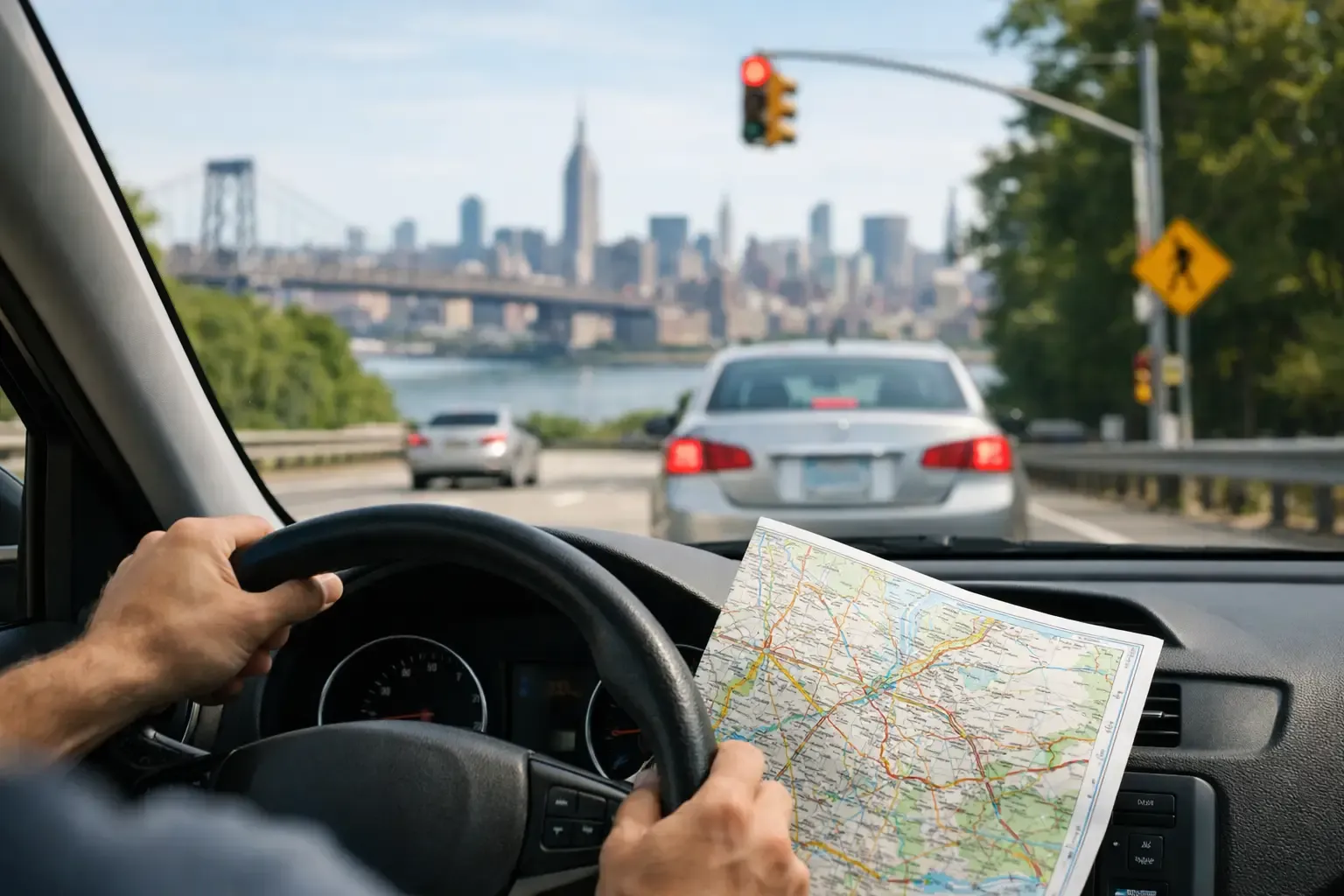
A road test is not won by memorizing turns. New York road test routes can change because of traffic, construction, weather, or the examiner’s judgment, but the driving skills they reveal remain the same. The goal is to show that you can control the car safely, observe your surroundings, and make calm decisions on real Brooklyn streets.
For many students, the route is the most stressful part of test day. You may worry about unfamiliar intersections, busy parking lanes, cyclists, or a command you did not expect. Focused practice replaces that uncertainty with a repeatable process: observe, signal, position the vehicle correctly, check for hazards, and complete the maneuver smoothly.
How New York Road Test Routes Really Work
A New York State road test usually begins near a designated testing location and takes place on nearby public streets. The examiner chooses directions based on the area and the skills they need to assess. There is no single official route that every applicant follows, even at the same location.
That means a route posted online may look useful but should never become your entire preparation plan. It can help you understand the character of an area, such as narrow residential streets or frequent stop signs. It cannot guarantee where your examiner will send you, what traffic conditions you will face, or when you will be asked to make a maneuver.
A good practice route includes the kinds of situations you are likely to encounter around a testing site: controlled and uncontrolled intersections, one-way streets, parked cars, pedestrian crossings, lane changes where appropriate, and a safe place to perform a three-point turn or parallel park. In Brooklyn, these situations often happen close together. Your instructor should help you learn to read the street rather than react late to it.
What the examiner is watching
The examiner is not looking for a perfect performance with no normal adjustments. They are evaluating whether your driving is safe, legal, controlled, and aware. Small errors can add up, while serious safety errors can end the test quickly.
They will pay close attention to whether you make complete stops, check mirrors and blind spots, use signals early enough, maintain proper lane position, yield when required, and keep a safe speed. They also watch how you respond when conditions are imperfect. A delivery truck may block your view, a pedestrian may step toward a crosswalk, or a driver may double-park. Slow down, look carefully, and make the safest legal choice.
Your observation must be visible. Quietly checking a mirror without moving your head may not be obvious to the examiner. Use natural head movements when checking mirrors, scanning intersections, and looking over your shoulder before pulling from the curb, changing lanes, or merging back into traffic.
Skills to Practice on Road Test Routes
Practice should be purposeful. Driving around for an hour can build comfort, but repeating the same easy streets will not prepare you for the decisions required on the exam. Use familiar roads first to build control, then add realistic test-area challenges with an instructor who can correct habits in the moment.
Stops, intersections, and right-of-way
Many road test mistakes happen at intersections. Approach every stop sign early enough to brake smoothly. Stop fully before the stop line, crosswalk, or intersection, then scan left, right, and left again before proceeding. Do not roll through a stop simply because the street appears empty.
At an uncontrolled intersection, reduce speed and prepare to yield. When turning, watch for pedestrians, bicycles, oncoming vehicles, and cars that may be turning into the same street. New York driving requires patience. Taking an extra moment to confirm that the path is clear is better than forcing a turn.
Pulling over and leaving the curb
Examiners commonly ask applicants to pull over, stop, and then re-enter traffic. This simple sequence tests several important habits at once. Signal, check your mirrors, choose a legal space, and pull in smoothly without hitting or crowding the curb.
Before leaving the curb, signal again and check mirrors and your blind spot. This is not a rushed maneuver. If traffic is approaching, wait until there is enough room to enter safely. A careful wait shows good judgment, not hesitation.
Parallel parking and the three-point turn
Parallel parking is often the maneuver students fear most because it feels highly visible. The real standard is practical control: position the car correctly, reverse slowly, use observation, and finish reasonably close to the curb without striking it. Touching the curb can cost points, while hitting it hard may be treated more seriously.
A three-point turn also requires patience. Check for approaching traffic and pedestrians before each movement. Turn smoothly, keep the vehicle under control, and avoid mounting the curb. If you need a minor correction and it is safe to make one, do it calmly rather than rushing.
Speed control on neighborhood streets
A quiet residential block is not an invitation to relax your attention. These streets can contain children, people exiting parked cars, cyclists, potholes, and vehicles pulling out unexpectedly. Keep to the posted speed limit and reduce speed whenever visibility is limited.
Driving too slowly can also create problems if it disrupts traffic without a reason. The right speed depends on conditions. Your instructor can help you learn the difference between cautious driving and uncertain driving, especially on narrow Brooklyn streets where parked vehicles make the lane feel tighter.
Why Route Memorization Can Hurt Your Test
Trying to memorize every turn may cause you to focus on the wrong thing. If the examiner changes the route, you may become distracted or miss a sign. Even worse, some students concentrate so heavily on anticipating the next instruction that they stop scanning for hazards.
Instead, learn a reliable routine for every new block. Look ahead for signs and lane markings. Check your speed. Notice parked cars, crosswalks, and traffic lights. Keep enough space from vehicles in front of you. When the examiner gives an instruction, listen fully, then complete it only when it is safe and legal.
If you do not hear an instruction, ask the examiner to repeat it. If a requested turn is unsafe or prohibited, do not make it. Continue safely and let the examiner direct you. Good driving is never about blindly following a command.
A Smarter Way to Prepare Before Test Day
The most effective preparation combines route familiarity with skill-focused lessons. Start by practicing the basic controls until braking, steering, signaling, and mirror checks feel natural. Then drive around the testing area under different conditions, including moderate traffic when possible. A route that feels easy on a quiet afternoon may require more awareness during busier hours.
Use at least one practice session to simulate the road test. Begin from the curb, follow directions without coaching, perform required maneuvers, and accept feedback only after the drive. This gives you a clearer picture of your current readiness than stopping after every mistake.
At Sky Light Driving School, one-to-one lessons are designed to target the skills that affect real road test performance, not just repeat a route. Practicing in a well-maintained vehicle with a patient instructor can help nervous first-time drivers, adult learners, and international drivers build the control and confidence New York roads demand.
The day before your exam, avoid cramming. Review your documents, confirm the test location and time, get enough rest, and choose comfortable footwear. On test day, arrive early, adjust your seat and mirrors, and take a moment before moving the car. A calm start helps you make better decisions from the first block to the last.
Are road test routes the same every day?
No. Examiners may use similar streets near a testing location, but the exact route can vary. Construction, traffic patterns, blocked streets, and the examiner’s choice can all change the drive. Prepare for the area and the required skills instead of depending on one route.
Should I practice at the exact road test location?
Yes, if you can do so safely and legally. Familiarity with the local street layout, signs, parking conditions, and common intersections can reduce anxiety. Still, use that familiarity to improve awareness, not to memorize a script.
Your license is meant to carry you beyond one testing neighborhood. Practice until each safe decision feels like your own, and the route on exam day becomes simply another drive you are ready to handle.
📅 Did You Know?
Practicing on diverse routes not only sharpens your driving skills but also boosts your confidence on test day! Embrace different scenarios and make mistakes in training—it's all part of becoming a safer, more aware driver. Your future on the road depends on it!


